
Introduction
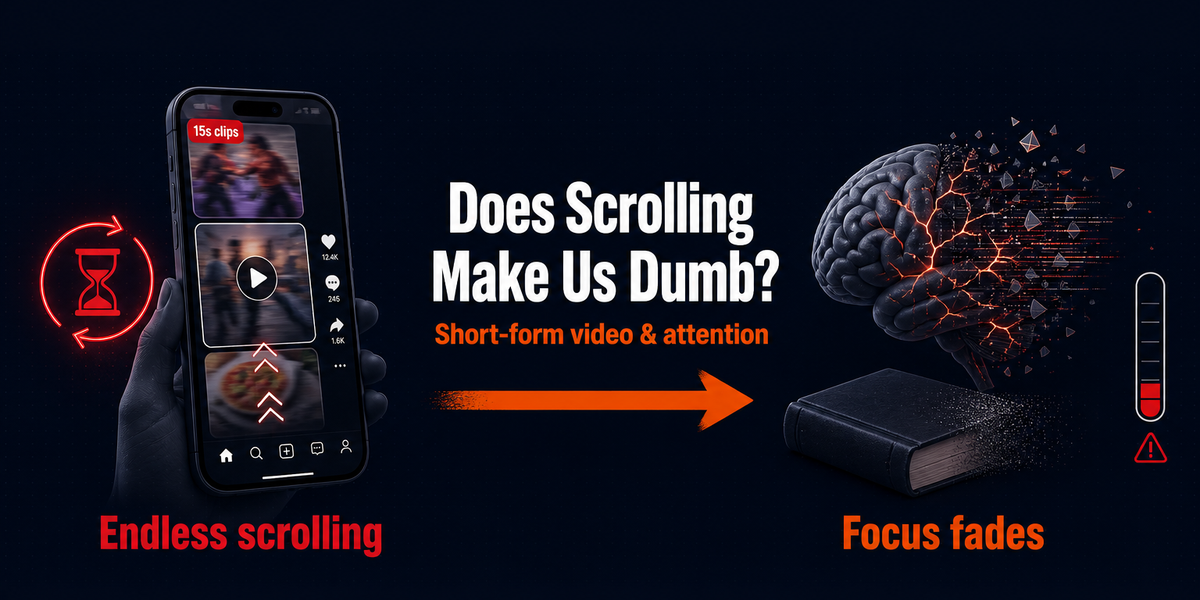
Most people who worry about short-form video talk about feeling distracted afterward—a book feels slow, a work task feels heavy, and stopping the feed feels harder than starting it. Surveys and attention tests hint that this is real. A 2026 NeuroImage study goes one step deeper: it watched the brain while people viewed short videos and asked a sharper question.
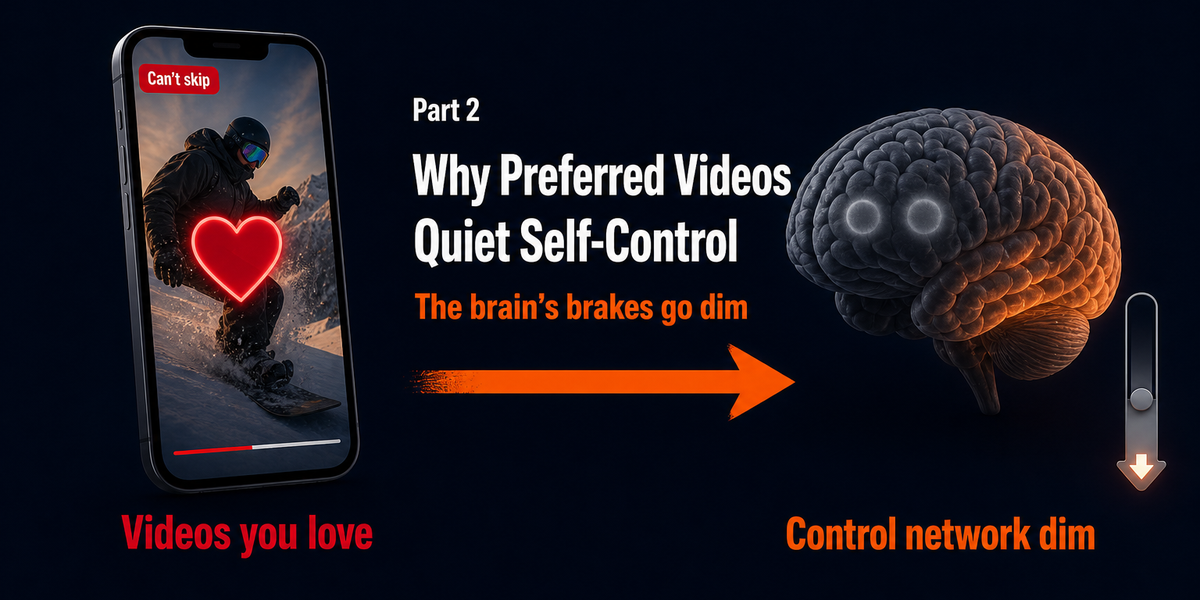
Do preferred short videos temporarily turn down the brain’s self-control network?
The answer, in their data, is largely yes—and that is why this paper is worth reading even if you are not a neuroscientist. It does not claim that short videos destroy intelligence. It shows something more specific and more damning for daily use: when a clip holds you, key control regions go quieter, and a brain chemical (glutamate) helps explain why some people show this pattern more than others.
My position: I am not a fan of short-form video, and I do not promote it. I am explaining this study because it gives a clear brain-level reason to treat preferred endless feeds as a bad deal for focus—not as content culture to celebrate.
Read the original study here: Brain activity inhibition during Short Video Viewing: neurochemical insights (ScienceDirect / NeuroImage).
Why this paper is a must-read
A lot of short-video commentary is opinion, anecdote, or correlation (“heavy users report worse focus”). This study stands out for four reasons:
- It measures the brain during viewing — not only questionnaires after the fact
- It separates preferred vs skipped clips — so immersion matters, not merely “looking at a screen”
- It is preregistered — the team locked key plans before analyzing, which raises research quality
- It connects chemistry to control — resting glutamate related to how strongly control regions deactivated
If you only read one recent paper on why reels feel sticky—and why that stickiness is a problem—this is a strong candidate: it shows preferred scrolling can switch off the mental brakes while you are still inside the feed.
What the researchers studied (in plain language)
The paper is titled Brain activity inhibition during Short Video Viewing: neurochemical insights, by Tiantian Hong, Conghui Su, Hui Zhou, Fengji Geng, and Yuzheng Hu, published in NeuroImage (2026).
They focused on two brain regions that help with cognitive control—the ability to monitor yourself, stay on task, and apply mental effort when needed:
- dACC (dorsal anterior cingulate cortex) — detects conflict, monitors behavior, helps decide when more control is needed
- dlPFC (dorsolateral prefrontal cortex) — helps apply control: focus, resist distraction, hold goals in mind
They also measured two chemicals at rest in the dACC using brain spectroscopy (MRS):
- Glutamate — the brain’s main “excitatory” messenger (helps drive activity)
- GABA — the brain’s main “inhibitory” messenger (helps calm or regulate activity)
Final sample: 56 young adults (average age about 23), after excluding people with too much head movement or poor chemistry-scan quality. Participants watched short-video blocks inside an fMRI scanner and could skip to the next clip. Videos watched to the end counted as preferred/“liked”; videos skipped early counted as less preferred/“disliked.”
What they found
1. Preferred videos quieted the control network
When people stayed with a clip to the end, both the dACC and dlPFC showed significant deactivation—activity fell below baseline. In everyday terms: the brain systems that usually help you monitor yourself and stay in charge looked quieter during immersive, preferred viewing.
2. Skipped videos looked different
For disliked/early-skipped videos, the pattern was not the same. dACC activity was closer to baseline, while dlPFC was still suppressed. Importantly, visual cortex stayed active for both liked and disliked clips—so this was not simply “eyes looking at a screen.” Preference and completion mattered.
3. Glutamate related to how strong the shutdown was
People with higher resting glutamate in the dACC showed less suppression of both control regions during viewing. GABA did not show a clear link in this study. That does not mean glutamate is “good” or “bad” in a moral sense; it means individual brain chemistry may help explain who slips deeper into that immersive, low-control state.
4. The two regions moved together more during preferred viewing
Connectivity between dACC and dlPFC increased, especially for preferred videos. The authors caution this does not automatically mean stronger self-control. A reasonable reading is that both regions were being downregulated in a more coordinated way during immersion.
What this means for everyday scrolling
Translate the lab finding into daily life carefully—and critically:
- It supports the “after scrolling, focus feels hard” complaint — preferred clips may temporarily dial down the network that helps with monitoring and control
- Immersion is the danger zone — clips you actually stay with matter more than clips you bounce past; the feed is built to find those clips for you
- This is a state during viewing — the study shows what happens in the moment, not that your IQ permanently drops
- People differ — chemistry and habits are not identical, which is not an excuse to keep a harmful default
My takeaway: preferred endless feeds create a brain state that is excellent for platform retention and weak for deliberate self-stopping. That is exactly when “just one more” becomes easy—and exactly why I do not promote this format.
For the broader picture—attention research, isolation, curated feeds, and why I recommend reducing or quitting—see Series Post 1: Does Short-Form Video Scrolling Make People Dumb? Next in the series (Post 3): Short-Video Addiction and Loss Aversion.
Read this study fairly—without watering it down
I will not oversell the paper. I also will not let its boundaries become an excuse to keep scrolling.
Do not claim more than the data shows
- Do not say it proved IQ collapse — this study measured brain activity during viewing, not lifelong intelligence scores
- Do not call it a full addiction diagnosis paper — it explains a control-network pattern; it did not diagnose “short-video addicts”
- Do not ignore how “preferred” was defined — clips watched to the end, which is close to real feed behavior: if it holds you, you stay
- Do not pretend one sample settles every age — it was mainly young adults; the warning still matters for anyone building the same habit
Still: the useful warning stands
Even with those borders, the finding that matters for daily life is clear: when short videos hold your attention, self-control regions go quieter. That is enough reason to treat the feed as hostile to focus—not as harmless entertainment waiting for a bigger study before you quit.
How to read the paper yourself
You do not need a neuroscience degree. Open the study and skim in this order:
- Abstract — the one-paragraph summary of question and findings
- Introduction — why dACC/dlPFC and short video matter
- Methods (lightly) — who participated, how liked vs disliked were defined, fMRI + MRS
- Results / figures — deactivation for preferred videos; glutamate link
- Discussion — interpretation, limits, and implications for self-regulation
Primary source (open on ScienceDirect):
https://www.sciencedirect.com/science/article/pii/S1053811926000406
Also citable as: Hong, T., Su, C., Zhou, H., Geng, F., & Hu, Y. (2026). Brain activity inhibition during Short Video Viewing: neurochemical insights. NeuroImage. DOI: 10.1016/j.neuroimage.2026.121722.
What I recommend (not a “healthy scrolling” guide)
If preferred clips quiet control systems in the moment, the smart response is not to celebrate better moderation tips—it is to stop giving the feed so many chances:
- Default to quitting or deleting the apps — willpower after immersion is the wrong tool
- If you still open them, set friction first — blockers, limits, grayscale; decide the stop rule before the first clip
- Never as a bridge after deep work — do not reward focus with a feed designed to undo it
- No bedtime preferred scrolling — that is when self-stopping is already weakest
- Replace the habit slot — reading, walking, calling someone, making something—anything that returns your attention intact
Conclusion
This NeuroImage study is a must-read because it replaces vague panic with a clear mechanism: preferred short videos can temporarily deactivate brain regions that support monitoring and cognitive control, and glutamate differences relate to how strongly that happens. That helps explain why immersive scrolling feels effortless to continue and why focus can feel sluggish afterward—without claiming that everyone is becoming less intelligent.
I am not promoting short video. I am pointing to evidence that the format works against the very control system you need to leave it. If this habit is part of your day, treat that as a problem to shrink—not a lifestyle to optimize. And if you want the evidence first-hand, go to the source:
Read the full study on ScienceDirect →
Research and further reading
- Hong et al. (2026) — Brain activity inhibition during Short Video Viewing (NeuroImage / ScienceDirect)
- Same paper via DOI
- Series Post 1 — Does Short-Form Video Scrolling Make People Dumb?
- Series Post 3 — Short-video addiction and loss aversion
- Liu et al. (2025) — Loss aversion and short-video addiction